
Paperless manufacturing
From route card to digital process
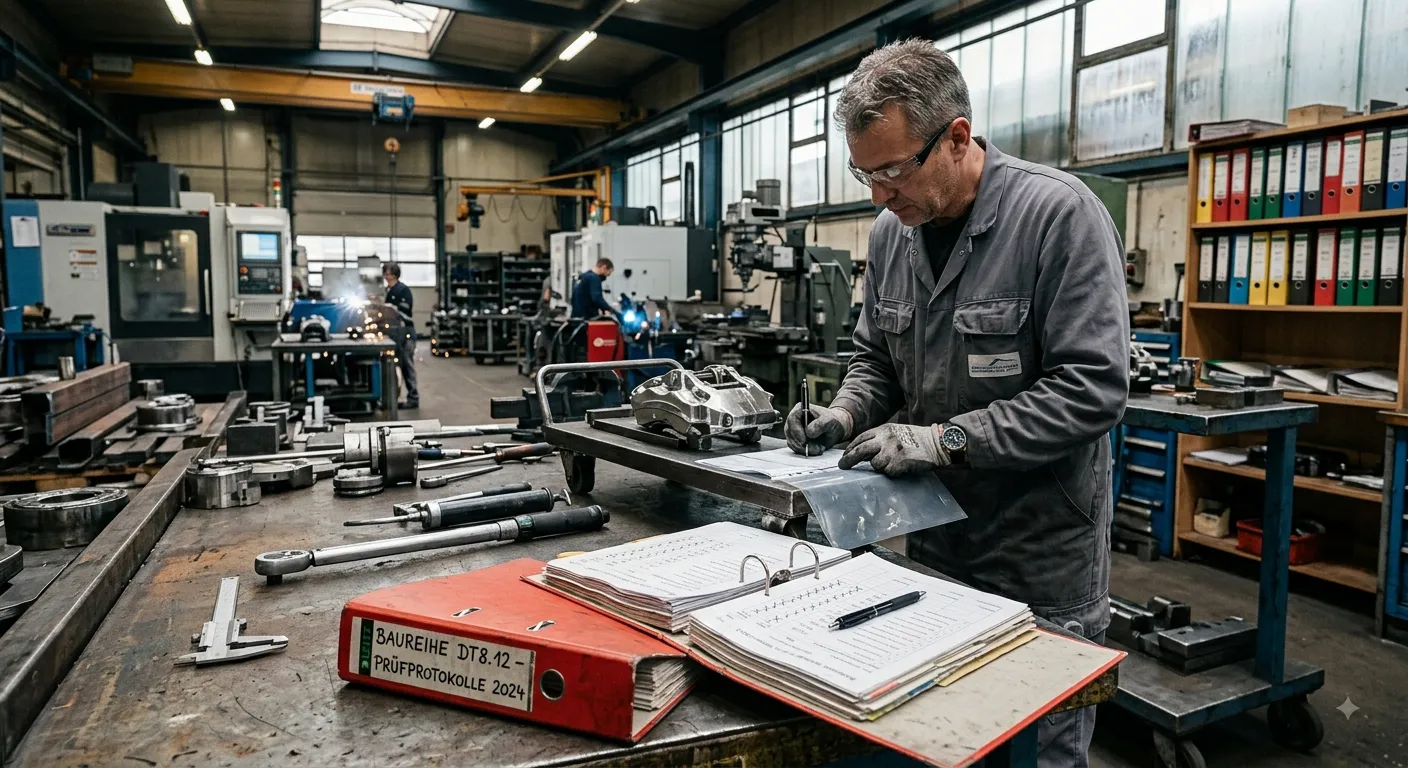
Your route card is right only on the day it was printed, and traceability ends at a tick in a binder. You spot mistakes at final test, or at your customer's.
 Traceability
 Quality
 Error prevention
 Paperless
 Proof on record
Starting point
You build components in lots of one to a few dozen. The variant count is high, the sequence is long, and your customer expects a build record for every unit and traceability down to the single component.
An order starts in the ERP. Someone prints it and assembles a binder: cover sheet, sequence of steps, parts list, drawing and work instructions. The binder rides on the trolley with the unit. Workers sign off each step in pen as they go. At the end the binder goes to the office, is checked for completeness and filed.
At the bench there is no screen and no worker guidance. There is the binder, the drawing and the kit.
Then your customer’s incoming inspection rejects two door modules out of eight. You open the binder, and every box is ticked. But the binder cannot tell you which bracket went into which unit, whether one step really happened after another, or which revision the bench was working from that week. So containment is not two units. It is all eight — and the four you have already shipped.
What goes wrong today
The plan is frozen before the first unit is touched
The plan lives in the ERP, and a printed copy of it travels the shop floor. That makes two versions, and production follows the one on the trolley. Engineering releases a revision on Tuesday; the binder came off the printer on Monday. Nothing at the bench shows the difference — a printed page looks just as authoritative on Wednesday as on the day it was current.
Nothing at the bench enforces the sequence
The sheet lists the steps in order. When the kit for one of them is late, the next step is started first and the earlier one is signed off once the parts arrive. Usually that is fine. Sometimes it is not, and the binder looks the same either way.
Whether the worker was allowed to do the work is a matter of trust
The sheet may say which qualification a step demands, but the only check is the worker's own knowledge that they hold it. Nothing stops the same pair of hands doing a step and signing off the one before it. And nothing records who did the work, only who wrote in the box.
Components go in by eye
The parts list calls for four brackets of one type and two of another, left and right, near-identical. The worker fits them from the kit. The binder then shows a tick against a line. Which part went into which position on which unit is recorded nowhere.
The record is finished after the work is
By the time the binder reaches the office, every signature is there. A binder is complete when it looks complete. Nothing in it tells a step signed off as it happened from one signed off at the end of the shift.
What changes
The steps are described once, not per order
Process engineering describes each step once and reuses it. An order's plan is then a matter of arranging those steps and setting, for each one, which steps must be finished first, which instruction it shows at which revision, and which qualification it takes to start and to complete it. Where a second pair of eyes is required, the rule sits on the dependency itself: whoever did the previous step cannot sign off this one. Rules that always apply are set once and take effect on every matching step, so nobody in process engineering has to remember them.
Worker guidance on screen replaces the sign-off in the binder
A worker badges in at a terminal under their own name and scans the unit in front of them. The screen shows only the steps that may be performed there, each marked not started, running or done. When they start a step, the instruction appears at exactly the revision that step was set up with, not whatever is current and not whatever is in the binder. The step will not start while a step it depends on is unfinished, or if the worker does not hold the qualification.
Components are scanned onto the unit, not ticked off
While the step runs, the worker scans each part. Every scan is matched against the order's parts list, narrowed to the positions that belong to that step, and recorded as this part, in this position, on this unit, together with the worker, the bench and the time. On a large assembly the worker moves through named zones rather than facing every position at once. A finished unit can itself be scanned as a component of a larger assembly, so a door module becomes part of the assembly it goes into.
Completion is a consequence, not a task
When the last open step is reported done, the unit is finished; when every unit is finished, so is the order. Nobody assembles the record afterwards, because it was written as the work happened. The document you hand your customer is generated from what was scanned and reported: every completed step with who, when and at which bench, and every parts-list position with what was assigned to it.
What you gain
Containment covers only the units actually affected
When a component turns out to be suspect, you read the records of the units in question instead of guessing. You quarantine those units rather than the whole lot. That holds for the ones you have already shipped as well.
Mistakes surface at the step instead of at final test
Feedback reaches the bench minutes after the decision, and it reaches the worker who made it. A step that cannot start out of sequence leaves no error for somebody to find two stations later.
A question about a shipped unit is answered the same day
You open that unit's record and read it, instead of working out which binder it was, finding it and hoping it says enough. Nobody chases missing signatures and nobody checks a returned binder for completeness, because no binder comes back.
You can still see what a record looked like in March
Every change to every record is kept in a log that is never edited and never deleted, with who made it, where and when. How something stood at an earlier date is a matter of reading it, not of hoping somebody kept a copy.
In use
Stadler Rail traces each train's configuration down to the component
At its Winterthur site, the rail vehicle manufacturer marks every part that matters to a vehicle's configuration with a code or tag and scans it, instead of checking and recording it by hand across production steps and sites. Recording now takes less effort, and the data is more reliable. The same system also gives workers project-specific instructions.
Read the full story →
Products used
 Hardware
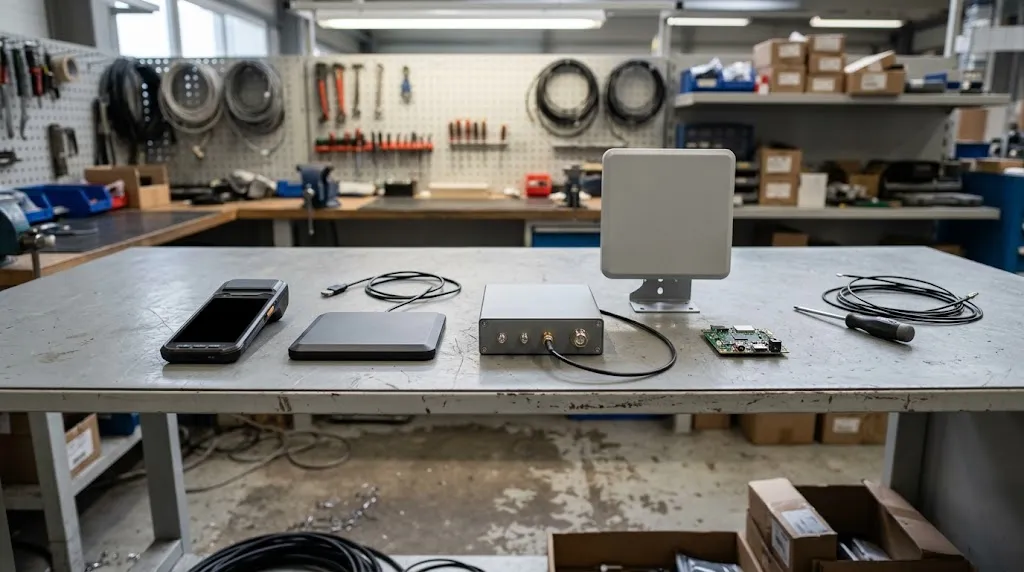
RFID readers and antennas
Handheld, desktop and fixed RFID readers, reader modules and antennas
Learn more →
 Hardware
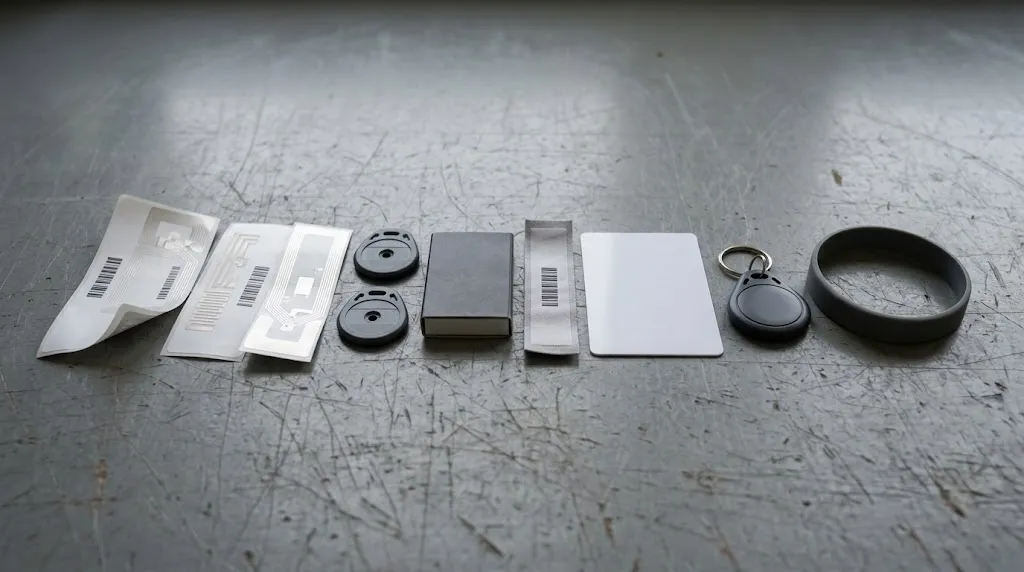
RFID transponders
Passive RFID tags for goods, equipment, metal, textiles and people
Learn more →
Tell us about your use case
Together, we work out whether and how your process can be digitized.